AP
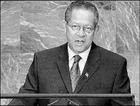
Prime Minister Bruce Golding addresses the 63rd session of the United Nations General Assembly at the United Nations headquarters on September 26.
The following is an excerpt of the address given by Prime Minister Bruce Golding at the 63rd session of the United Nations General Assembly in New York on September 26, 2008.
Mr President, I offer you my congratulations on your presidency. You assume this office at a time when the world faces challenges of crisis pro-portions. Much will be demanded of your leadership and you can be assured of Jamaica's full support and cooperation.
We have convened amidst worrying global developments.
The hopes of the new millen-nium are in danger of fading as the ideals of international harmony and shared global prosperity remain illusive.
Globalisation, despite increasing production and expanding trade, has been uneven in the spread of its benefits and, for many countries, marginal in its impact. Indeed, it has widened the gap between rich and poor within and among countries.
The global economy now appears to be headed for a severe downturn. Developments in the global financial system, the painful increase in oil and commodity prices and the escalating food crisis threaten to plunge vast sections of the world's population deeper into poverty. Fiscal challenges and the crippling burden of debt render many countries incapable of responding to this crisis. We are called upon to respond within our limited capacity to protect the most vulnerable.
Developing countries
In the long term, however, our hopes for survival will require huge investments, improved productivity, better access to the world's markets and human capacity building. Developing countries cannot be left to find their own solutions. The situation requires a collaborative, coordinated, global response. This is not mere altruism. It is an indis-putable truth that if developed countries assist developing coun-tries to improve their economies, their productive capacity and the purchasing power of their people, they will expand the markets for their own goods and services. It is the interdependency which we share and which is manifested in so many other areas, from climate change to global epidemics, organised crime and human trafficking.
Solving the problem of developing countries requires more than mere liberalisation of trade, privatisation and the free flow of capital. It requires a sincere and sustained effort that focuses on the limitations that bedevil developing countries. Global development, not just global markets, must be at the centre of our priorities.
Poverty and wealth should not have to co-exist. Poverty can be eradicated. The tools of develop-ment exist and are capable of transforming the world, empowering the poor and enabling them to rise from their poverty. We must commit ourselves to creating a world in which not everyone may be rich, but no one has to be poor.
Millennium Development Goals
In 2001, we committed ourselves to achieving the Millennium Development Goals by 2015. We are now at the halfway mark and we are behind schedule. It is time to take stock to see where we are falling behind, who is falling behind and what must be done to make up lost ground.
A critical success factor must be the partnership between developed and developing countries as defined in the 2002 Monterrey Consensus on Financing for Development, integrating aid, debt relief, market access, good governance and foreign direct investment. These initiatives were carefully calibrated. Proceeding with some elements without the others will not achieve the goals we have set. Indeed, it might make it worse.
We must all pull up our socks if we are to reverse the slippage we have suffered. Developing countries must ensure that their priorities are properly structured. Developed countries must live up to their commitment to devote 0.7 per cent of their gross domestic product to official development assistance. This is a modest amount. Yet, only five countries have to date done so.
The focus of development cooperation cannot be too narrowly defined. The varied economic and social profiles of developing coun-tries require a more flexible response that recognises investment in human capital, infrastructure and the transfer of technology as critical elements in reducing poverty in a sustained way.
This is particularly important to developing countries that are class-ified, based on per capita income, as middle-income countries. This classification deprives them of access to concessionary financing and creative measures to reduce the crippling debt burden that afflicts so many of them. If we are to reduce poverty, the peculiar circumstances of these countries cannot be ignored since that is where more than one third of the world's poor is to be found.
We call on the international community to devise strategic programmes to address the peculiar needs of middle-income countries with deep pockets of poverty. Because of these factors and our exposure to frequent natural disasters, Jamaica and its CARICOM partners are proposing the international recognition of CARICOM states as a special category of small vulnerable and highly indebted middle-income countries.
Equitable International Trading System
Another urgent task is the creation of a viable and equitable international trading regime. Jamaica is deeply disappointed that the Doha Development Round has failed to deliver on the promise of an open, fair and predictable multilateral trading system. We urge all parties to resolve the outstanding differences particularly on the removal of trade-distorting agricultural subsidies, as well as the need for special safeguard mechanisms for economically challenged countries.
Our intense focus on combating terrorism, transnational organised crime, elimination of nuclear arms and other weapons of mass destruction, must not marginalise the need for decisive action to curb the illicit trade in small arms which facilitate internal violence in many of our countries and result in high levels of homicides. Jamaica supports the establishment of an arms trade treaty to impose strict controls on the illegal trade in small arms and ammunition.
The United Nations must continue to play a pivotal role through its peacekeeping missions to create sustainable peace in post-conflict situations. Jamaica will use its membership of the Peace Building Commission to underscore the importance of sustained, long-term economic development in rebuilding and transforming countries that have been wracked by conflict.
The devastation wrought on Haiti by recent hurricanes has aggravated the already harsh conditions under which the Haitian people are forced to live. Much more needs to be done, not only in providing emergency relief, but in addressing the long-term social, economic and development needs of that country, as a sustainable solution to the fragile humanitarian situation that exists there. Haiti needs and deserves the support of the entire international community.
United Nations reform
We gather here as members of that union we call the United Nations. What is the state of that union?
We must not ignore the cynicism that exists in some quarters about the continued value of the United Nations. Those cynics have not bothered to contemplate what the world would be like if the United Nations did not exist. We have contributed to that cynicism, so often bending the facts to suit our own design, breaking the rules to secure a particular advantage, making commitments without the will to honour those commitments.
The reform of the United Nations structure and procedures is an imperative whose time has long come. Let's not bury it in procrastination and incessant squabbling. It is time for constructive, consensus-building dialogue. The need for changes in the structure and scope of the Security Council has been under discussion for almost 15 years, bogged down in polarised, adversarial positions.
We have a compelling duty to put in place the systems that can secure peace and prosperity for the future. We, therefore, welcome the unanimous adoption of the General Assembly Resolution 62/557, which we hope will provide the resolve for the early commencement of inter-governmental negotiations within a specified timeframe and in the context of an informal plenary of the General Assembly.